Part 1
Selective and Nonselective Vascular Catheterization, Angiography, and Vascular Diagnostic Studies Above the Diaphragm
This two-hour training course (Part 1) introduces you to the VIR specialty and the concepts of nonselective and selective catheterization and imaging, order of selectivity, and surgical and radiology component coding. Along with a vascular anatomy primer, it also covers diagnostic studies on the cervicocerebral arteries, upper extremity arteries, and thoracic aorta and intercostal arteries.
Objectives:
Lesson 1: Introduction to Vascular Interventional Radiology
- Differentiate between nonselective and selective catheterization
- Distinguish selective imaging from nonselective imaging
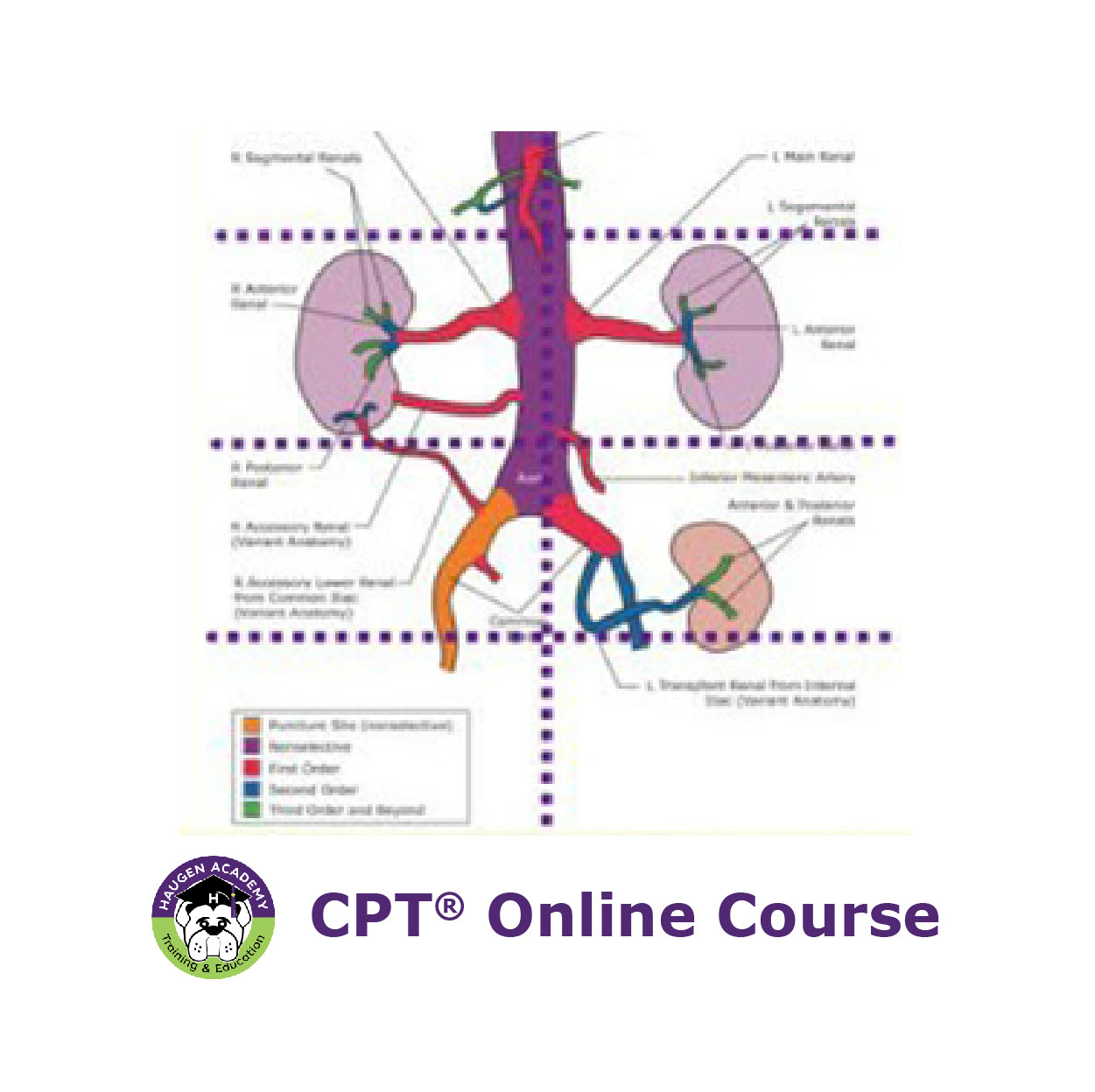
- Identify vascular families on an anatomical diagram
Lesson 2: Diagnostic Studies on the Cervicocerebral Arteries
- Distinguish between carotid and vertebral artery circulation
- Identify when an arch aortogram is bundled into other imaging
- List the cervicocerebral angiography codes in the order of the hierarchy
Lesson 3: Diagnostic Studies on the Upper Extremity Arteries
- Apply the order of selectivity to assign catheterization codes for upper extremity angiography
- Select radiology codes for the contrast injection and S&I for upper extremity angiography
- Distinguish between subclavian injection for cervicocerebral angiography and upper extremity angiography
Lesson 4: Diagnostic Studies on the Thoracic Aorta and Intercostals
- Distinguish between thoracic aortogram and arch aortogram
- Determine when to use codes for visceral angiography when the intercostals are injected
CE Credits:
AHIMA
This program has been approved for 2 continuing education units for use in fulfilling the continued education requirements of the American Health Information Management Association (AHIMA). Granting prior approval from AHIMA does not constitute endorsement of the program content or its program sponsor.
- Domain: Data Structure, Content, and Information Governance
AAPC
This program has the prior approval of the American Academy for Professional Coders (AAPC) for 2 continuing education hours. Granting of prior approval in no way constitutes endorsement by AAPC of the program content or the program sponsor.
- Specialty CEUs: COC, CPC, CPC-P, CCC, CCVTC, CPB, CPPM
Target Audience:
- Facility outpatient coders
- Billing professionals
- Charge master analysts
- Other staff involved in charging for infusion services
Part 2
Vascular Diagnostic Studies Below the Diaphragm
This one-hour training course (Part 2) continues with diagnostic studies performed on the abdominal aorta, visceral arteries, and lower extremity arteries.
Objectives:
Lesson 1: Diagnostic Studies: Abdominal Aorta and Visceral Arteries
- Determine when a flush aortogram is bundled
- Differentiate between bundled and component coding for renal and other visceral angiography
- Identify three major vascular families off the abdominal aorta
Lesson 2: Diagnostic Studies: Pelvic Arteries
- Distinguish between pelvic arteries and arteries of the lower extremity
- Determine when to use selective pelvic angiography codes
Lesson 3: Diagnostic Studies on the Lower Extremity Arteries
- Apply order of selectivity to determine appropriate catheterization codes
- Assign codes to various types of run-off procedures
CE Credits:
AHIMA
This program has been approved for 2 continuing education units for use in fulfilling the continued education requirements of the American Health Information Management Association (AHIMA). Granting prior approval from AHIMA does not constitute endorsement of the program content or its program sponsor.
- Domain: Data Structure, Content, and Information Governance
AAPC
This program has the prior approval of the American Academy for Professional Coders (AAPC) for 2 continuing education hours. Granting of prior approval in no way constitutes endorsement by AAPC of the program content or the program sponsor.
- Specialty CEUs: COC, CPC, CPC-P, CCC, CCVTC, CPB, CPPM
Target Audience:
- Facility outpatient coders
- Billing professionals
- Charge master analysts
- Other staff involved in charging for infusion services
Part 3
Arterial Revascularization
This two-hour course (Part 3) covers primary revascularization procedures (angioplasty, stenting, and atherectomy) for the arterial system.
Objectives:
Lesson 1: Introduction to Revascularization and the Cervicocerebral Arteries
- Differentiate between different types of revascularization procedures
- Determine when a diagnostic angiography can be coded in addition to a vascular intervention
- Determine when to use codes from the cardiovascular subsection and nervous system subsection when reporting angioplasty and stenting of the carotid arteries and intracranial arteries
- Differentiate between cervical and intrathoracic carotid arteries
Lesson 2: Lower Extremity Artery Revascularization
- Place revascularization procedures in order according to the hierarchy
- Match leg arteries to their respective territories
- Determine how many codes can be assigned per territory and per leg
- Identify procedures that are bundled into lower extremity revascularization procedure codes
Lesson 3: Other Revascularization Procedures
- Identify procedures that can be coded separately from angioplasty and stenting
- Identify situations in which arterial stent codes should be used in place of lower extremity revascularization codes
CE Credits:
AHIMA
This program has been approved for 2 continuing education units for use in fulfilling the continued education requirements of the American Health Information Management Association (AHIMA). Granting prior approval from AHIMA does not constitute endorsement of the program content or its program sponsor.
- Domain: Data Structure, Content, and Information Governance
AAPC
This program has the prior approval of the American Academy for Professional Coders (AAPC) for 2 continuing education hours. Granting of prior approval in no way constitutes endorsement by AAPC of the program content or the program sponsor.
- Specialty CEUs: COC, CPC, CPC-P, CCC, CCVTC, CPB, CPPM
Target Audience:
- Facility outpatient coders
- Billing professionals
- Charge master analysts
- Other staff involved in charging for infusion services
Part 4
Venous Interventional Radiology and Procedures on the Dialysis Circuit
This one-hour course (Part 4) delves into diagnostic studies and therapeutic interventions on the veins. This course also presents the anatomy and coding of vascular interventions on the dialysis circuit.
Objectives:
Lesson 1: Venous Diagnostic Studies and Vascular Interventions
- Identify the order of selectivity of the venous system
- Determine which venous vascular interventions require a bundled versus a component coding approach
Lesson 2: Interventions on Arteriovenous Shunts and Arterial Bypass Grafts
- Differentiate between the peripheral and central segments of the dialysis circuit
- Apply the dialysis circuit code hierarchy rules to coding scenarios
- Determine when to use arterial versus venous codes for cases involving bypass grafts
CE Credits:
AHIMA
This program has been approved for 2 continuing education units for use in fulfilling the continued education requirements of the American Health Information Management Association (AHIMA). Granting prior approval from AHIMA does not constitute endorsement of the program content or its program sponsor.
- Domain: Data Structure, Content, and Information Governance
AAPC
This program has the prior approval of the American Academy for Professional Coders (AAPC) for 2 continuing education hours. Granting of prior approval in no way constitutes endorsement by AAPC of the program content or the program sponsor.
- Specialty CEUs: COC, CPC, CPC-P, CCC, CCVTC, CPB, CPPM
Target Audience:
- Facility outpatient coders
- Billing professionals
- Charge master analysts
- Other staff involved in charging for infusion services
Part 5
Thrombectomy, Thrombolysis, and Embolization Procedures
This one-hour training course (Part 5) continues with other vascular interventions that may be performed on either the arterial or venous system, such as thrombectomy, thrombolysis, drug infusion, and embolization procedures.
Objectives:
Lesson 1: Thrombectomy, Thrombolysis, and Drug Infusions
- Determine when transcatheter thrombolysis codes are reportable
- Differentiate between primary and secondary thrombectomy
Lesson 2: Embolization
- Classify various vascular conditions as hemorrhage, tumor, and other indications for embolization
- Determine when to use S&I codes for embolization procedures and follow-up angiography following embolization
CE Credits:
AHIMA
This program has been approved for 2 continuing education units for use in fulfilling the continued education requirements of the American Health Information Management Association (AHIMA). Granting prior approval from AHIMA does not constitute endorsement of the program content or its program sponsor.
- Domain: Data Structure, Content, and Information Governance
AAPC
This program has the prior approval of the American Academy for Professional Coders (AAPC) for 2 continuing education hours. Granting of prior approval in no way constitutes endorsement by AAPC of the program content or the program sponsor.
- Specialty CEUs: COC, CPC, CPC-P, CCC, CCVTC, CPB, CPPM
Target Audience:
- Facility outpatient coders
- Billing professionals
- Charge master analysts
- Other staff involved in charging for infusion services
Part 6
Pulmonary Artery, Portal Vein, and Venous Access Device Procedures
This two-hour course (Part 6) includes coding instruction for diagnostic and therapeutic procedures performed on the pulmonary arteries and portal venous system. It also presents coding instruction for central venous catheterization procedures, such as dialysis permacaths and chemotherapy infusion ports.
Objectives:
Lesson 1: Pulmonary Artery and Portal Vein Procedures
- Identify the pulmonary arteries as nonselective, selective, or segmental
- Determine when to use code 75774 for additional pulmonary artery imaging
- Assign codes for portal vein catheterization
Lesson 2: Central Venous Catheterizations
- Identify the veins CPT classifies as central veins
- Differentiate between a centrally placed and peripherally placed central catheter
- Determine when to use removal vs. replacement codes for central venous catheters
- Indicate situations where it is appropriate to code imaging guidance for central venous catheter placement
CE Credits:
AHIMA
This program has been approved for 2 continuing education units for use in fulfilling the continued education requirements of the American Health Information Management Association (AHIMA). Granting prior approval from AHIMA does not constitute endorsement of the program content or its program sponsor.
- Domain: Data Structure, Content, and Information Governance
AAPC
This program has the prior approval of the American Academy for Professional Coders (AAPC) for 2 continuing education hours. Granting of prior approval in no way constitutes endorsement by AAPC of the program content or the program sponsor.
- Specialty CEUs: COC, CPC, CPC-P, CCC, CCVTC, CPB, CPPM
Target Audience:
- Facility outpatient coders
- Billing professionals
- Charge master analysts
- Other staff involved in charging for infusion services
Part 7
Endovascular Aneurysm Repair
This one-hour training course (Part 7) addresses topics that are listed on Medicare’s inpatient only list under the outpatient prospective payment system (OPPS). This optional course is intended for professional fee coders who assign codes for physicians in the inpatient setting. In this series of lessons, we discuss the various types of endovascular aneurysm repair, including repairs of the abdominal and thoracic aorta and iliac arteries as well as fenestrated endovascular aneurysm repair (FEVAR).
Objectives:
Lesson 1: Abdominal Aorta and Iliac Artery Endovascular Repair
- Identify the common types of abdominal aorta endograft devices
- Determine when to code extension grafts
- Recognize procedures that are bundled into endograft codes
Lesson 2: Thoracic Endovascular Repair and Fenestrated Grafts
- Identify procedures that are bundled into thoracic aneurysm repair codes
- Determine which procedures can be coded during the same episode as fenestrated endovascular aortic repair (FEVAR) placement
CE Credits:
AHIMA
This program has been approved for 2 continuing education units for use in fulfilling the continued education requirements of the American Health Information Management Association (AHIMA). Granting prior approval from AHIMA does not constitute endorsement of the program content or its program sponsor.
- Domain: Data Structure, Content, and Information Governance
AAPC
This program has the prior approval of the American Academy for Professional Coders (AAPC) for 2 continuing education hours. Granting of prior approval in no way constitutes endorsement by AAPC of the program content or the program sponsor.
- Specialty CEUs: COC, CPC, CPC-P, CCC, CCVTC, CPB, CPPM
Target Audience:
- Facility outpatient coders
- Billing professionals
- Charge master analysts
- Other staff involved in charging for infusion services
Purchasing Details
- The price of this series includes the AMA Royalty Fees
- Upon purchase, you will have a 6-month subscription to this course. This will allow you the opportunity to complete and review as often as you like for 6 months.
- Courses are accessed through www.haugenacademy.com.
- Visit our FAQ page for technical requirements and additional details.



180 reviews for Coding for Vascular Interventional Radiology Series
I would recommend more scenarios throughout the course.
I think my brain is on overload. I have takin in so much information in such a short time that I can’t keep track of things.
This is a challenging course. I feel like I could spent a lot more time on the Dialysis and graft coding.
This was a difficult course. The rules and what is included with each procedure get jumbled in my head.
great illustrations
Tough stuff! I got through it but am dizzy with all the potential options. Trying to keep it all straight.
It would be so helpful to include some op notes in the educational portion of this webinar. Reading the op reports gets this jumbled in my head.
I believe this was very easy to follow and understand. I highly recommend
great information