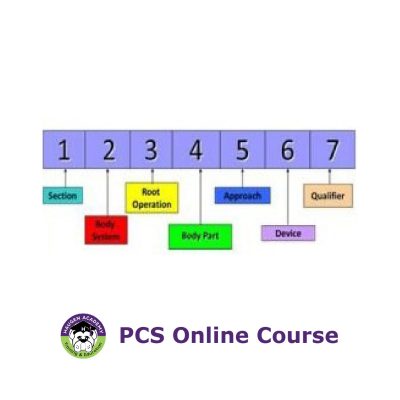
Codes Discussed: ICD-10-PCS (International Classification of Diseases, 10th Revision, Procedure Coding System), ICD-10-CM (diagnosis coding system referenced in course/resources), CPT/HCPCS (referenced in contrast to PCS as other procedure coding systems), Guideline A1 (PCS codes are composed of seven characters), Guideline A2 (34 possible character values; numbers 0-9 and letters except I and O), Guideline A3 (new valid values can be assigned as PCS expands), Guideline A4 (single value meaning depends on preceding values), Guideline A5 (values become increasingly dependent on preceding values as the system expands), Guideline A6 (index may be used to locate PCS tables), Guideline A7 (tables must be used to construct valid PCS codes; index use is not required but helpful), Guideline A8 (all seven characters must be specified for a valid PCS code), Guideline A9 (characters 4-7 must be selected from the same row of a PCS table), Guideline A10 (“and” means “and/or” except when describing combinations of separate body parts), Guideline A11 (coder may translate documentation terms into PCS root operation definitions), Guideline B2.1a (general anatomical regions body systems), Guideline B2.1b (upper/lower body part values divided by diaphragm), Guideline B3.1a (apply full root operation definition), Guideline B3.1b (integral components and operative approach/closure not coded separately), Guideline B3.2 (multiple procedure coding), Guideline B3.2b (distinct body part multiple procedure guidance), Guideline B3.2c (multiple root operations with distinct objectives on same body part), Guideline B3.2d (intended root operation attempted by one approach and completed by another), Guideline B3.3 (discontinued procedures), Guideline B3.4a (biopsy root operations with diagnostic qualifier), Guideline B3.4b (biopsy followed by definitive treatment coded separately), Guideline B3.5 (overlapping body layers), Guideline B3.6a (bypass body part from and qualifier to), Guideline B3.6b (coronary artery bypass body part and qualifier rules), Guideline B3.6c (multiple coronary bypass codes when device and/or qualifier differ), Guideline B3.7 (Control versus more specific root operations), Guideline B3.8 (Excision versus Resection), Guideline B3.9 (Excision for graft), Guideline B3.10a (spinal fusion body part by vertebral joint level), Guideline B3.10b (separate spinal fusion code when device and/or qualifier differs), Guideline B3.10c (spinal fusion device hierarchy), Guideline B3.11a (Inspection not coded separately when integral to same approach procedure), Guideline B3.11b (Inspection of multiple tubular/non-tubular body parts), Guideline B3.11c (Inspection coded separately when different approach), Guideline B3.12 (Occlusion versus Restriction for vessel embolization), Guideline B3.13 (Release body part is body part being freed), Guideline B3.14 (Release versus Division), Guideline B3.15 (Reposition for fracture treatment), Guideline B3.16 (Transplantation versus Administration), Guideline B3.17 (Transfer using multiple tissue layers), Guideline B3.18 (Excision/Resection followed by Replacement), Guideline B3.19 (Detachment procedures of extremities), Guideline B4.1a (portion of body part without separate value coded to whole body part), Guideline B4.1b (“peri” body part coding), Guideline B4.1c (overlapping lesion in tubular body part coded to body part closest to heart), Guideline B4.2 (branches of body parts and closest proximal branch), Guideline B4.3 (bilateral body part values), Guideline B4.4 (coronary arteries classified by number treated), Guideline B4.5 (tendons, ligaments, bursae, and fascia near a joint), Guideline B4.6 (skin, subcutaneous tissue, and fascia overlying a joint), Guideline B4.7 (fingers/toes coded to hand/foot when no specific value exists), Guideline B4.8 (upper and lower intestinal tract), Guideline B5.2a (open procedure with percutaneous endoscopic assistance coded open), Guideline B5.2b (percutaneous endoscopic approach with hand assistance/incision/extension), Guideline B5.3a (External approach for visible structures within an orifice), Guideline B5.3b (External approach for indirect external force), Guideline B5.4 (percutaneous procedure via device), Guideline B6.1 (device general guidelines), Guideline B6.2 (drainage device guideline), Guideline C1 (Obstetrics section for procedures on products of conception), Guideline C2 (procedures following delivery or abortion), Guideline D1.a (Brachytherapy delivery and radioactive element insertion), Guideline D1.b (temporary brachytherapy applicator insertion), Guideline E1.a (New Technology Section X codes are standalone codes), Guideline E1.b (New Technology codes subject to multiple procedure guideline), UHDDS principal procedure guidelines, Section 0 (Medical and Surgical section), Section X (New Technology section), 0W9 (General Anatomical Regions Drainage table referenced for pleural cavity drainage), 0JH (Subcutaneous Tissue and Fascia Insertion table reference), invalid 0JHW3VZ (invalid PCS code because device value V is not in same row as body part value W), 0KX (Muscle Transfer table), 0DJ (Gastrointestinal System Inspection table), 0WJ (General Anatomical Regions Inspection table), 04CJ0ZZ (Extirpation of matter from left external iliac artery, open approach), 059 (Drainage of upper veins table), 08Q (Repair, Eye table for canthorrhaphy), 0N8 (Division, Head and Facial Bones table for cranial osteoclasis), 0DV (Restriction, Stomach table for gastroplication), 06H03DZ (Insertion of intraluminal device into inferior vena cava, percutaneous approach/IVC filter placement), 0D1N0Z4 (Bypass sigmoid colon to cutaneous, open approach/colostomy creation), 0FN04ZZ (Release of liver, percutaneous endoscopic approach/laparoscopic lysis of liver adhesions), 0SQC4ZZ (incorrect code for arthroscopic repair of right posterior cruciate ligament because posterior cruciate ligament is not a joint structure), 0W4 (Creation table referenced for gender reassignment), Excision, Resection, Extraction, Repair, Inspection, Bypass, Control, Restriction, Occlusion, Release, Division, Reposition, Transplantation, Administration, Transfer, Replacement, Fusion, Insertion, Drainage, Destruction, Delivery, Abortion, Brachytherapy, Dilation, Extirpation, Creation, Alteration, Device value A (Interbody fusion device), Device value D (Intraluminal device), Device value 0 (Drainage device), Device value Z (No device), Qualifier value Z (No qualifier), Qualifier value 4 (Cutaneous), Qualifier value 8 (New Technology group for FY 2023 codes), Qualifier value 9 (New Technology group for FY 2024 codes), Upper Intestinal Tract body part value 0, External Carotid Artery Left body part value N, Products of Conception Retained, Products of Conception, Endometrium, STEMI (ST-elevation myocardial infarction), PTCA (Percutaneous transluminal coronary angioplasty), LAD (Left anterior descending artery), IVC (Inferior vena cava), K-wires, Cook Celect IVC filter, drug-eluting stents, bare metal stent, interbody fusion device, bone bank bone, autologous tissue substitute, nonautologous tissue substitute, synthetic substitute, vascular stent, neurostimulator, joint replacement, hernia mesh, PTCA balloon, chest staples, chest tube, Foley catheter, biliary drainage catheter, GammaTile, Cesium-131, Palladium-103, TAVR (Transcatheter aortic valve replacement), dual filter cerebral embolic filtration, magnetically controlled growth rods
Topics Covered: ICD-10-PCS coding guidelines, ICD-10-PCS coding resources, ICD-10-PCS official guidelines, PCS coding conventions, Medical and Surgical section guidelines, Obstetrics section guidelines, Radiation Therapy section guidelines, New Technology section guidelines, Selection of Principal Procedure, ICD-10-PCS Index use, ICD-10-PCS Tables use, code building process, seven-character PCS codes, axis of classification, valid PCS characters, alphanumeric character values, letters I and O excluded, expansion of PCS values, same-row table selection, valid PCS code construction, invalid PCS code identification, “and” meaning “and/or” in PCS, root operation definition application, provider documentation translation, partial resection as Excision, physician query avoidance, PCS character meanings, Section character, Body System character, Root Operation character, Body Part character, Approach character, Device character, Qualifier character, general anatomical regions coding, anatomical region versus specific body part, drainage of body cavity, pleural cavity drainage coding, chest tube drainage coding, upper and lower body system values, diaphragm as dividing line, upper veins body system, lower veins body system, full root operation definition, integral procedure components, operative approach not coded separately, incision not coded separately, port placement not coded separately, operative site closure not coded separately, anastomosis integral to bypass, multiple PCS procedure coding, multiple procedures on distinct body parts, multiple root operations on same body part, intended procedure attempted by one approach and completed by another, discontinued procedure coding, Inspection for discontinued procedures, open inspection of mediastinum, biopsy procedure coding, diagnostic qualifier, biopsy followed by definitive treatment, overlapping body layers, deepest layer coding, debridement coding, musculoskeletal layered repair, right lower leg laceration repair, subcutaneous tissue and fascia repair, Bypass procedure coding, bypass from and bypass to coding, body part bypassed from, bypass qualifier destination, stomach to jejunum bypass, coronary artery bypass coding, coronary arteries classified by number treated, coronary artery source of blood flow, aortocoronary bypass, internal mammary coronary artery bypass, greater saphenous vein graft harvest, separate device and qualifier bypass codes, Control versus definitive root operations, acute bleeding control, postprocedural bleeding control, hemostasis coding, Occlusion as more definitive bleeding control, Excision versus Resection coding, lung lobe resection, named body part subdivision coding, graft harvest coding, autograft from different procedure site, DIEP flap exception, spinal fusion coding, vertebral joint level selection, cervicothoracic junction, thoracolumbar junction, upper joints versus lower joints, L1 vertebra dividing line, spinal fusion device hierarchy, interbody fusion device, autologous bone graft, nonautologous bone graft, bone bank bone, Inspection procedure coding, laparoscopic cholecystectomy inspection bundling, cystourethroscopy body part selection, bladder and ureter inspection, exploratory laparotomy, peritoneal cavity inspection, laparoscopic converted to open procedure, different approach inspection coding, Occlusion versus Restriction, vessel embolization coding, complete vessel closure, lumen narrowing, Release procedure coding, body part being freed, intestinal adhesion lysis, Release versus Division, spinal nerve root release, spinal nerve root division, scar tissue removal around nerve, nerve root cutting, fracture treatment coding, displaced fracture reduction, cast and splint not separately coded, Transplantation versus Administration, mature functioning living body part transplant, autologous cells, nonautologous cells, bone marrow coding, pancreatic islet cells, stem cells, transfer flap coding, multiple tissue layer transfer, deepest layer transferred, skin and subcutaneous tissue qualifier, excision/resection followed by replacement, removal integral to replacement, detachment procedure qualifiers, amputation level qualifiers, body part value assignment, portion of body part coded to whole body part, alveolar mandible coding, “peri” prefix coding, perirenal as kidney, continuous tubular body part coding, body part closest to heart, iliofemoral endarterectomy coding, external iliac artery coding, branch body part coding, closest proximal branch rule, trigeminal nerve branch coding, mandibular branch of trigeminal nerve, cardiovascular body system branch exception, bronchial artery coding, upper artery body part value, bilateral body part value coding, bilateral inguinal hernia repair, coronary artery angioplasty coding, coronary artery body part by number treated, same root operation/approach/device coronary coding, drug-eluting stent versus bare metal stent, tendons near joint coding, ligaments near joint coding, bursae near joint coding, fascia near joint coding, knee ligament coding, posterior cruciate ligament coding, articular cartilage joint coding, skin overlying joint coding, subcutaneous tissue overlying joint coding, fascia overlying joint coding, finger and toe coding, finger muscle coded to hand muscle, toe procedures coded to foot when no toe value exists, upper intestinal tract definition, lower intestinal tract definition, esophagus to duodenum, jejunum to rectum and anus, open approach coding, percutaneous endoscopic assistance, hand-assisted laparoscopic procedure coding, incision extension in laparoscopic procedure, external approach coding, tonsillectomy external approach, closed fracture reduction external approach, percutaneous procedure through device, percutaneous nephrolithotripsy, kidney stone fragmentation and removal, PCS device definition, device left in place, removable devices, devices not coded when integral, procedures performed on devices, drainage device coding, chest tube device coding, Foley catheter device coding, biliary drainage catheter coding, Obstetrics section coding, products of conception coding, procedures on pregnant female coding, perineal laceration repair in Medical and Surgical section, retained products of conception evacuation, postpartum curettage, post-abortion curettage, D&C outside postpartum/post-abortion period, Radiation Therapy section coding, brachytherapy coding, localized radioactive material, radioactive element insertion, GammaTile coding, collagen matrix radioactive seed placement, temporary brachytherapy applicator coding, hollow needle applicator insertion, New Technology Section X coding, new technology equipment, new technology drugs, sixth character distinguishing feature, seventh character new technology group, standalone New Technology codes, supplemental code misconception, dual filter cerebral embolic filtration, TAVR separate procedure coding, magnetically controlled growth rods, concomitant spinal fusion coding, UHDDS principal procedure selection, definitive procedure sequencing, diagnostic procedure sequencing, procedure most related to principal diagnosis, secondary diagnosis procedure sequencing, Indexing root operations, laparoscopy index entry, fasciectomy index entry, phlebotomy index entry, basilic vein drainage, TRAM procedure indexing, free TRAM flap, pedicled TRAM flap, clipping aneurysm indexing, Restriction using extraluminal device, body part key, body part classification, false vocal cord coded to larynx, anatomical term to PCS term cross references, Code Purple practice, Code Red ultimate coder challenge, ORIF distal radius fracture, open reduction internal fixation coding, right distal radius fracture, K-wire fixation, inferior vena cava filter placement, ultrasound guidance, fluoroscopic guidance, right internal jugular vein access, percutaneous IVC filter insertion, colonoscopy coding, colonoscopy with polypectomy, sigmoid colon polyp excision, snare polypectomy, hot biopsy forceps, polyp cauterization, Excision and Destruction on same body part, sigmoid resection with colostomy, sigmoid colon bypass to skin, cutaneous qualifier, laparoscopic lysis of adhesions, liver release, abdominal wall adhesions, arthroscopic posterior cruciate ligament repair, knee bursae and ligament body system, chest tube placement coding, pleural cavity body part, retained products of conception extraction, incomplete abortion, maxillary artery exploration, internal maxillary artery aneurysm, external carotid artery body part, maxillary artery ligation, Occlusion root operation, STEMI cardiac cath case, left heart catheterization, coronary angiogram, drug-eluting stent placement, definitive procedure selection, medical coding guideline education, ICD-10-PCS inpatient procedure coding education, PCS case study coding, coding guideline application, medical coding course content


engaging
Haugen Academy is my first choice for EDUs because they are friendly, reasonably priced, and the courses are to access. If you need to contact for any reason, the response time is reasonable.
GOOD
GOOD
GOOD
GOOD
GOOD
GOOD
GOOD
good
It clarified problem areas I had.