Codes Discussed: No specific ICD-10-CM, ICD-10-PCS, CPT, or HCPCS code values are explicitly listed in the hepatobiliary course handout; MS-DRG (Medicare Severity Diagnosis Related Group assignment), APR DRG (All Patient Refined Diagnosis Related Group), MCC (Major complication or comorbidity), SOI 2 (Severity of illness level 2 for unspecified hepatic failure), SOI 4 (Severity of illness level 4 for acute/subacute hepatic failure and hepatorenal syndrome), ROM 3 (Risk of mortality level 3), ROM 4 (Risk of mortality level 4), PDX (Principal diagnosis), diseases of the digestive system K00-K95 (ICD-10-CM Chapter 11 code range referenced in course content/references)
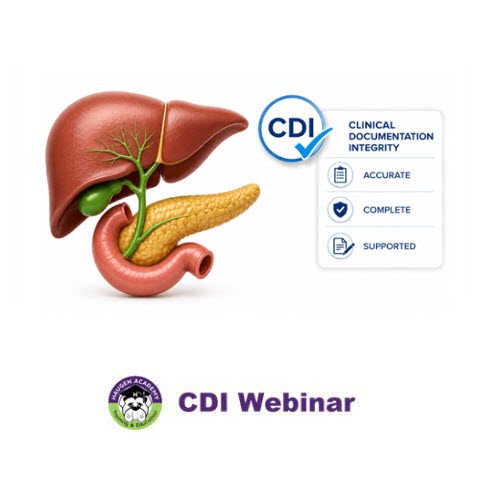
Topics Covered: clinical documentation integrity for hepatobiliary diagnoses, CDI hepatobiliary system strategies, hepatobiliary CDI, hepatobiliary documentation review, pancreatic disorder documentation, UHDDS guidelines, ICD-10-CM documentation principles, ICD-10-PCS documentation principles, diagnosis specificity, compliant provider queries, clinical indicators, complications, comorbid conditions, severity of illness capture, SOI capture, risk of mortality capture, ROM capture, accurate code assignment, principal diagnosis strategies, liver failure documentation, pancreatitis documentation, gallbladder documentation, hepatorenal syndrome documentation, cirrhosis documentation, signs and symptoms documentation, abdominal pain, nausea and vomiting, jaundice, abdominal distention, ascites, definitive diagnosis query, ascites documentation, malignant ascites, jaundice documentation, pre-hepatic jaundice, hepatic jaundice, post-hepatic jaundice, hepatobiliary differential diagnosis, cirrhosis, hepatitis, cholelithiasis, malignancy, pancreatitis, pancreatic inflammation, pancreatic damage, acute pancreatitis, chronic pancreatitis, gallstone pancreatitis, biliary pancreatitis, cytomegalovirus pancreatitis, idiopathic pancreatitis, alcohol-induced pancreatitis, drug-induced pancreatitis, gangrenous pancreatitis, interstitial pancreatitis, cystic pancreatitis, recurrent pancreatitis, relapsing pancreatitis, medication-induced pancreatitis, pancreatic cancer complication, liver cancer complication, gallbladder surgery-associated pancreatitis, high triglycerides, pancreatitis acuity query, pancreatitis etiology query, electrolyte imbalance due to dehydration, malnutrition documentation, malabsorption documentation, steatorrhea documentation, pancreatic cyst, pancreatic pseudocyst, SIRS due to pancreatitis, sepsis due to pancreatitis, severe sepsis due to pancreatitis, pancreatic infection, diabetes mellitus complication, acute cholecystitis with cholelithiasis, cholelithiasis principal diagnosis, gallstone pancreatitis as MCC, liver disease documentation, stages of liver disease, steatosis, steatohepatitis, liver fibrosis, cirrhosis stage, liver failure stage, end stage liver disease, chronic liver disease, alcohol-related liver disease, alcoholic hepatitis, alcoholic cirrhosis, Laennec’s cirrhosis, post-necrotic cirrhosis, macronodular cirrhosis, micronodular cirrhosis, biliary cirrhosis, primary biliary cirrhosis, secondary biliary cirrhosis, cholangiolitic cirrhosis, cholangitic cirrhosis, hypertrophic cirrhosis, Hanot’s cirrhosis, Todd’s cirrhosis, obstructive cirrhosis, monolobar cirrhosis, unilobar cirrhosis, Charcot’s cirrhosis, xanthomatous cirrhosis, hepatitis cirrhosis, hepatitis A, hepatitis B, hepatitis C, NASH cirrhosis, autoimmune cirrhosis, cryptogenic cirrhosis, congenital cirrhosis, portal cirrhosis, nutritional cirrhosis, alcohol use documentation, alcohol abuse documentation, alcohol dependence documentation, alcohol withdrawal, delirium tremens, portal hypertension, liver infection, liver cancer, gallstones, insulin resistance, type 2 diabetes, viral hepatitis documentation, active hepatitis versus hepatitis carrier, acute hepatitis, chronic hepatitis, hepatitis A transmission, hepatitis B transmission, hepatitis C screening, hepatitis C liver transplant risk, hepatocellular necrosis, inflammatory cell infiltration, hepatitis manifestations, fatigue, flu-like symptoms, loss of appetite, portal hypertension complication, kidney failure complication, hepatic encephalopathy complication, unspecified necrosis of liver with coma, unspecified necrosis of liver without coma, acute necrosis of liver, hepatic coma, hepatorenal syndrome, hepatic infarction, shock liver, HRS criteria, low GFR, serum creatinine, creatinine clearance, proteinuria, obstructive uropathy exclusion, intrinsic parenchymal disease exclusion, acute hepatic failure, subacute hepatic failure, postprocedural hepatorenal syndrome, hepatic encephalopathy, altered mental status, AMS documentation, confusion, disorientation, combativeness, gait disturbance, altered level of consciousness, deep coma, elevated ammonia, neurotoxic blood ammonia, hepatic encephalopathy Type A, hepatic encephalopathy Type B, hepatic encephalopathy Type C, portal-systemic bypass, portal-systemic shunts, acute liver failure, cirrhosis with portal hypertension, hepatic failure with coma, hepatic failure without coma, chronic hepatic failure, acute/subacute hepatic failure, lactulose treatment, fatty liver documentation, hepatic steatosis, simple fatty liver, obesity and fatty liver, rapid weight loss and fatty liver, medication side effect fatty liver, gallbladder disease documentation, biliary tract disease, cholecystitis, gallbladder inflammation, cystic duct obstruction, bile stasis, gallbladder necrosis, gallbladder perforation, hydrops of gallbladder, mucocele of gallbladder, gallstone disease, cholelithiasis documentation, cholecystitis documentation, acute cholecystitis, chronic cholecystitis, acute on chronic cholecystitis, choledocholithiasis, bile duct calculus, calculi in bile ducts, biliary tract obstruction, cholangitis, gallstone pancreatitis complication, anatomical location of stones, common bile duct stone documentation, CBD documentation, post cholecystectomy syndrome, gallbladder perforation documentation, microperforation documentation, gallbladder abscess, peritonitis, sepsis due to gallbladder disease, procedural complication documentation, right shoulder pain, right upper quadrant pain, RUQ pain, abdominal pain radiating to back and arm, pain between shoulder blades, bile duct inflammation, cholangitis documentation, acute cholangitis, chronic cholangitis, cholangitis with calculus, cholangitis with obstruction, cholangitis without obstruction, primary sclerosing cholangitis, PSC documentation, fistula of bile duct, ascending cholangitis, recurrent cholangitis, sclerosing cholangitis, secondary cholangitis, stenosing cholangitis, suppurative cholangitis, bile duct stricture, bile duct patency, liver transplant for PSC, biliary obstruction, ERCP complication documentation, ERCP stent placement, provider linkage for complication coding, gallstone pancreatitis after ERCP, substance use specificity, drug use documentation, nicotine use documentation, nicotine abuse documentation, nicotine dependence documentation, retained cholelithiasis after cholecystectomy, accidental puncture and laceration of digestive system organ, operative report review, hepatobiliary procedures, surgical DRG selection, organ and approach documentation, Whipple procedure documentation, pancreaticoduodenectomy, conventional Whipple, pylorus-sparing Whipple, pancreas head removal, duodenum removal, gallbladder removal, stomach partial removal, common bile duct removal, digestive tract reconstruction, ICD-10-PCS root operation Excision, ICD-10-PCS root operation Resection, bypass not appropriate for Whipple, anastomosis inherent to Whipple, procedure body part specificity, body part biopsied, body part removed, body part repaired, body part repositioned, laterality documentation, external approach, open approach, percutaneous approach, percutaneous endoscopic approach, bypass beginning point, bypass endpoint, hepatic duct to small intestine bypass, anastomosis body part documentation, vessel connection documentation, extent of tissue removed, lymph node biopsy documentation, number of lymph nodes removed, whole lymph node chain removal, cholecystectomy documentation, open cholecystectomy, laparoscopic cholecystectomy, percutaneous endoscopic cholecystectomy, converted laparoscopic to open procedure, common bile duct exploration, CDE documentation, Ampulla of Vater dilation, Sphincter of Oddi dilation, hepatic device complication, intrahepatic infusion pump infection, sepsis due to infected hepatic device, device complication principal diagnosis, liver biopsy, percutaneous liver biopsy, transjugular liver biopsy, intraoperative liver biopsy, laparoscopic liver biopsy, open liver biopsy, wedge liver biopsy, microscopic liver tissue examination, pancreatitis query example, pancreatitis acuity clarification, acute pancreatitis as principal diagnosis, acute pancreatitis as MCC, chronic pancreatitis not usually principal diagnosis, acute exacerbation of chronic pancreatitis, hepatic encephalopathy query example, metabolic encephalopathy query, altered mental status query, elevated bilirubin, low platelet count, elevated AST, elevated ALT



There are no reviews yet. Be the first one to write one.