Description
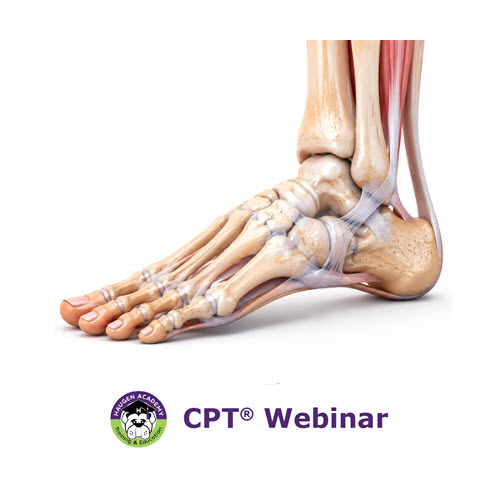
Put your best foot forward and strut into this lively session on foot and ankle repair coding! We’re taking a detailed stroll into the world of foot and ankle procedures—the kind that keep patients (and their coders) on their toes.
You’ll decode op notes, master tricky terminology, and tackle CPT coding for tendon releases, Achilles repairs, ligament reconstructions, and more. We’ll clear up CMS bundling rules, highlight how anatomy drives coding decisions, and work through real-world cases like fusions and calcaneus ORIF—no tiptoeing around the tough stuff here!
Whether you’re new to orthopedic coding or just need a confidence boost, this session will help you stride through case documentation and strut away with the skills to code foot and ankle repairs like a pro.
Objectives:
- Integrate coding principles with clinical scenarios to improve accuracy, reduce denials, and support medical necessity
- Distinguish CPT coding nuances for tendon release and Achilles tendon repair, including anatomical and procedural variations
- Differentiate deep vs. superficial procedures and explain how depth impacts CPT code selection and reimbursement
- Identify how foot laterality (medial vs. lateral) influences CPT coding choices for common foot and ankle surgeries
- Appropriately reporting all CPT’s applicable when multiple procedures are performed through a single incision, ensuring accurate and compliant coding
- Review CPT codes and documentation requirements for ligament reconstruction, joint fusions, and calcaneus open reduction internal fixation (ORIF)
View a quick lesson from this webinar on coding fasciotomy.
Read the webinar Q&A on the Haugen Advantage.
Codes Discussed: 28420 (Open treatment of calcaneal fracture with fixation and bone graft, including obtaining graft), 27695 (Primary repair of collateral ligament, medial or lateral ankle, for acute injury), 27696 (Primary repair of both collateral ligaments for acute ankle injuries), 27698 (Secondary repair of collateral ligament for chronic instability or reconstruction, including Broström-type repair), 27829 (Open treatment of distal tibiofibular joint disruption/syndesmotic instability), 28238 (Reconstruction of posterior tibial tendon), 27814 (Open treatment of bimalleolar ankle fracture, referenced with syndesmotic screw fixation), modifier 59 (Distinct procedural service modifier), modifier XS (Separate structure modifier), 27676 (Repair of dislocating peroneal tendons with fibular groove deepening), 27605 (Percutaneous Achilles tendon tenotomy with local anesthesia), 27606 (Percutaneous Achilles tendon tenotomy with general anesthesia), 27612 (Posterior capsular release ankle arthrotomy with or without Achilles tendon lengthening), 27650 (Primary Achilles tendon repair), 27652 (Primary Achilles tendon repair with graft), 27654 (Secondary Achilles tendon repair with graft), 27685 (Lengthening or shortening of single tendon of leg or ankle), 27686 (Lengthening or shortening of multiple tendons of leg or ankle, each), 20924 (Tendon graft harvest, noted as not separately applicable when inherent to secondary Achilles repair), 28008 (Fasciotomy of foot and/or toe), 28008-59/XS (Separate fasciotomy of foot and/or toe through distinct incision), 28060 (Partial fasciectomy of plantar fascia), 28062 (Radical fasciectomy of plantar fascia), 28035 (Posterior tibial nerve decompression/tarsal tunnel release), 27815 (Triple arthrodesis), 28300 (Calcaneal osteotomy for realignment), 28725 (Subtalar joint arthrodesis)
Topics Covered: foot and ankle repair coding, CPT foot and ankle coding, foot anatomy for coding, ankle anatomy for coding, foot bones coding, ankle ligaments coding, foot regions coding, hindfoot coding, midfoot coding, forefoot coding, laterality in foot and ankle coding, operative note interpretation, structure-based CPT selection, anatomy-driven CPT coding, procedure intent documentation, surgical exposure versus treated structure, superficial versus deep procedures, tendon release coding, tendon repair coding, tendon reconstruction coding, tendon debridement documentation, tendon sheath incision documentation, synovectomy documentation, foot and ankle reconstruction coding, alignment versus fusion coding, multiple procedures through one incision, NCCI bundling, NCCI unbundling, CPT documentation requirements, coding based on work performed, calcaneus fracture ORIF coding, calcaneal fracture coding, intra-articular calcaneus fracture, posterior facet fracture, subtalar joint involvement, autogenous bone graft coding, iliac crest bone graft, hindfoot fracture fixation, ankle ligament coding, ATFL coding, anterior talofibular ligament, CFL coding, calcaneofibular ligament, deltoid ligament coding, AITFL coding, anterior inferior tibiofibular ligament, syndesmotic ligament coding, high ankle sprain coding, distal tibiofibular joint disruption, syndesmotic fixation coding, syndesmotic screw coding, ORIF ankle fracture coding, modifier 59 usage, modifier XS usage, acute ligament repair coding, chronic ankle instability coding, secondary ligament repair coding, Broström procedure coding, Watson-Jones procedure coding, Chrisman-Snook procedure coding, Gould augmentation coding, posterior tibial tendon reconstruction, flatfoot correction coding, cavovarus reconstruction coding, tendon transfer coding, calcaneal osteotomy coding, lateral ankle ligament repair, distinct pathology documentation, muscle imbalance correction, bony malalignment correction, ligamentous instability correction, global reconstruction coding, peroneal tendon reconstruction coding, peroneus brevis tendon repair, dislocating peroneal tendon repair, peroneal tendon subluxation, fibular groove deepening, superior peroneal retinaculum reconstruction, tendon tracking documentation, Achilles tendon repair coding, Achilles rupture coding, primary Achilles repair, secondary Achilles repair, chronic Achilles rupture, delayed Achilles rupture, re-ruptured Achilles tendon, Achilles tendon graft, Achilles tendon augmentation, Achilles tendon lengthening coding, Achilles tenotomy coding, open Achilles lengthening, percutaneous Achilles release, equinus contracture coding, ankle dorsiflexion limitation, Z-lengthening, open tendon exposure, local anesthesia tenotomy, general anesthesia tenotomy, posterior capsular release, ankle arthrotomy coding, tendon graft harvest bundling, debridement integral to tendon reconstruction, foot compartment anatomy, fasciotomy coding, fasciectomy coding, plantar fascia coding, compartment pressure release, compartment decompression coding, medial foot compartment release, lateral foot compartment release, fasciotomy per incision, plantar fasciotomy versus fasciotomy, partial plantar fasciectomy, radical plantar fasciectomy, plantar fascia excision, plantar fascia resection, medial band plantar fascia, central band plantar fascia, posterior tibial nerve decompression, tarsal tunnel syndrome coding, nerve entrapment coding, neurolysis coding, flexor retinaculum release, fascia opening versus nerve decompression, documentation insufficiency, vague operative note documentation, procedure not defined, posterior tibial tendon treatment documentation, arthrodesis coding, foot fusion coding, ankle fusion coding, joint fusion documentation, joint preparation documentation, cartilage removal, fixation across fusion site, triple arthrodesis coding, subtalar joint fusion, talonavicular joint fusion, calcaneocuboid joint fusion, hindfoot arthritis coding, hindfoot instability, hindfoot deformity correction, subtalar arthritis coding, subtalar realignment coding, calcaneal osteotomy for realignment, preserved joint surfaces, compression screw fixation, arthrodesis versus osteotomy, CPT coding pitfalls, foot and ankle coding denials, foot and ankle audit risk, documentation-driven CPT selection, repair versus release versus reconstruction, decompression versus realignment versus stabilization versus fusion, foot and ankle webinar content